STRICT QUALITY CONTROL SYSTEM

STRICT QUALITY CONTROL SYSTEM

Why Does PVC Foam Develop Bubbles and Lose Its Cell Structure?
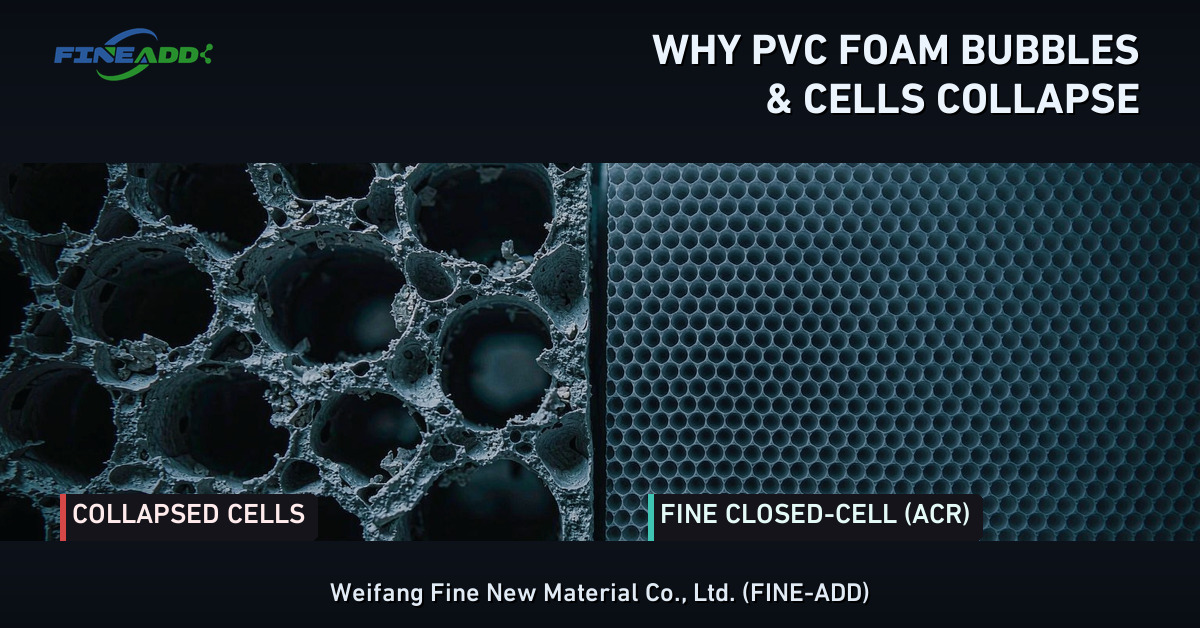
PVC foam does not collapse by accident. Bubbles, core voids and coarse, uneven cells are the visible result of a simple physical contest: the gas pressure generated by the blowing agent versus the strength of the PVC melt holding it in. When the melt is strong enough, gas is locked into millions of fine, closed cells. When it is not, cells merge, rupture and collapse into large voids — and the board comes out light in spots, weak and prone to cracking. High-molecular-weight acrylic processing aids (ACR foam regulators) exist to tip that balance in your favour.
Every foamed PVC product starts with a chemical blowing agent, typically azodicarbonamide (AC/ADC). When the melt reaches its decomposition temperature, the agent releases gas (mainly nitrogen, with CO and CO₂). Three stages follow:
Nucleation — dissolved gas comes out of solution and forms microscopic bubble nuclei throughout the melt.
Cell growth — as more gas is generated and temperature rises, each nucleus expands. The surrounding melt is stretched into a thin cell wall.
Stabilisation or collapse — if the cell wall has enough melt strength and elasticity, it holds. If not, neighbouring cells merge (coalescence), the wall ruptures, and gas escapes into large voids.
The decisive variable in stage three is melt strength — the elastic resistance of the polymer to being stretched. Unmodified rigid PVC has inherently low melt strength at foaming temperature. That is the starting point for almost every bubble defect.
This is the primary cause. When the PVC melt lacks adequate elasticity and viscosity, the thin cell walls formed by the blowing agent burst under internal gas pressure. The result is cell coalescence, large internal voids and uneven foam density — the classic "collapse" seen at high line speeds.
Foaming only works if gas generation and PVC gelation are synchronised. If the blowing agent decomposes before the PVC particles have fully fused, gas is released into a weak, granular melt with no continuous structure to trap it. The gas escapes or forms irregular pockets instead of a uniform cell structure.
PVC is thermally sensitive: the gap between its fusion/processing temperature and the onset of degradation is small, and it overlaps with the blowing-agent decomposition range. Push the barrel hotter to speed up fusion and you risk degradation, which shortens polymer chains and weakens the melt. Run cooler and fusion is incomplete. Either side of the window produces unstable foam.
External and internal lubricants control where and when the PVC plasticises along the barrel. Too much external lubricant delays fusion and leaves unmelted particles; too much internal lubricant over-softens the melt. Both shift the plasticisation zone away from the foaming zone, so gas expands in a melt that is not ready to hold it.
Inadequate or uneven gelation — often made worse by poorly dispersed impact modifiers — leaves internal stress-concentration points in the PVC matrix. These weak spots rupture first under cell pressure and later become the initiation sites for edge cracking and brittle failure.
High-molecular-weight acrylic processing aids are not just lubricants or flow promoters. In foamed PVC they act as melt-strength builders and cell-structure controllers. Their long polymer chains entangle with PVC chains, raising melt elasticity and viscosity at foaming temperature.
| Root cause | What ACR changes | Result in the board |
|---|---|---|
| Low melt strength | Increases melt elasticity and extensional viscosity so cell walls resist gas pressure | Cells stay separate and intact; no coalescence or core voids |
| Gas ahead of fusion | Promotes faster, more uniform gelation so a continuous melt exists when gas is released | Fine, even nucleation instead of irregular pockets |
| Narrow temperature window | Broadens the viable processing range by strengthening the melt across temperatures | More forgiving processing, less scrap from temperature drift |
| Lubricant imbalance | Works with a balanced lubricant package to stabilise plasticisation | Consistent fusion and steady extrusion torque |
| Poor gelation / weak points | Improves dispersion and gelation quality throughout the matrix | Fewer weak points, better impact and edge strength |
Typical dosage: a high-molecular-weight foam regulator is generally used at 4.0–8.0 phr for PVC foam board, adjusted to the grade, line speed and target density. For rigid pipe and profile, a general processing-aid ACR is used at roughly 1.0–2.0 phr.
With the right ACR foam regulator and a balanced formulation, the difference is visible in the cut section: instead of scattered large holes and a hollow core, you get a dense skin and a fine, uniform closed-cell structure. That structure translates directly into three measurable gains — lower and more consistent density, a smoother surface with fewer defects, and markedly better impact and edge strength.
Pairing the ACR foam regulator with CPE 135A adds low-temperature impact toughness to the fine cell structure, so the board resists brittle cracking as well as collapse. See our high-speed extrusion cell-collapse guide for the full three-step formulation strategy, and our PVC foam regulator product page for grade specifications.
Large internal bubbles mean cells have merged or ruptured. The usual cause is melt strength too low to hold the blowing-agent gas pressure, often worsened by gas being released before the PVC has fully fused. A high-molecular-weight ACR foam regulator raises melt strength and speeds uniform gelation, keeping cells fine and separate.
Not by the agent alone. The blowing agent supplies the gas, but collapse happens when the melt cannot hold that gas. The same agent produces fine closed cells in a well-stabilised formulation and coarse voids in a weak melt. Melt strength and fusion quality are the deciding factors.
A high-molecular-weight foam regulator is typically dosed at 4.0–8.0 phr for PVC foam board. Start within that range and adjust for your grade, line speed and target density; higher line speeds and lower target densities generally need more melt strength.
Rarely on its own. Lowering temperature slows blowing-agent decomposition but also delays PVC fusion, which can leave the melt too weak. The durable fix is to build melt strength with an ACR foam regulator and balance the lubricant package, then fine-tune temperature within the processing window.
Both are acrylic processing aids, but a foam regulator is a high-molecular-weight grade specifically designed to build the melt strength and elasticity needed to stabilise foam cells. A general processing aid at 1.0–2.0 phr mainly improves fusion and surface in rigid, non-foamed PVC.
Yes. By promoting uniform gelation and stabilising cell structure, ACR reduces surface roughness, pinholes and sink marks caused by cells breaking at the skin. A balanced ACR and CPE 135A package addresses both surface quality and impact strength.
Weifang Fine New Material Co., Ltd. (FINE-ADD) is a manufacturer of PVC additives including high-molecular-weight ACR processing aids and foam regulators, high-stability CPE 135A impact modifiers, and specialty rubber. Our technical team supports customers worldwide with formulation advice, sample testing and dosage optimisation for foam board, WPC, pipe and profile extrusion.
TALK TO AN ACR SPECIALIST
Send us your application, PVC grade and target density. We will recommend the matching ACR grade, share the technical data sheet and arrange a free sample — no obligation.
CALL / WHATSAPP
Email: info@fine-additive.comVisit www.fine-add.com
Free samples • Technical data sheet • Formulation support • Reply within 24 hours
INQUIRE IMMEDIATELY

Chlorinated polymers and PVC additives, formulated in-house and shipped worldwide from Weifang, Shandong.
No.8868 Guting Street, Weifang Economic Development Zone, Shandong Province, P.R.China.
Join our newsletter to stay up to date on features and releases.
By subscribing you agree to with our Privacy Policy and provide consent to receive updates from our company.
©2025 weifang fine new material co.,ltd All Rights Reserved.
Powered by HiCheng
